
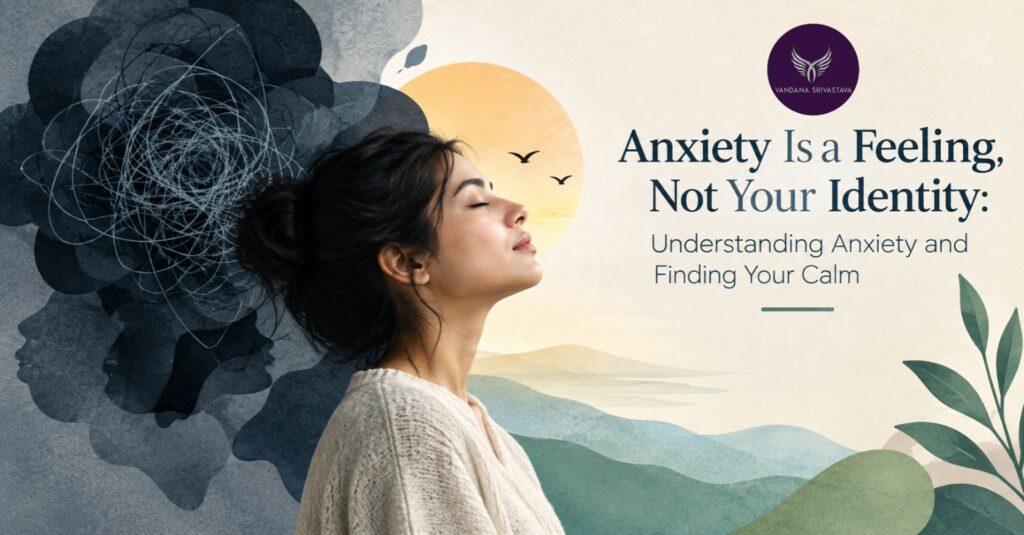
Anxiety can make even an ordinary day feel difficult.
Your mind keeps running through possibilities. You replay conversations. You worry about what might happen tomorrow. Sometimes, you know there is no immediate danger, yet your body still feels tense and your thoughts refuse to slow down.
And then comes another thought:
“Why am I like this?”
But anxiety is not a definition of who you are.
You are not your racing thoughts. You are not your fear. You are not the constant “what ifs” running through your mind.
Anxiety is a feeling. And feelings can be understood, managed, and supported.
What Is Anxiety?
Anxiety is a natural response to stress or perceived danger. Everyone experiences worry or nervousness from time to time.
It can become difficult when these feelings are frequent, intense, or begin interfering with everyday life.
An anxious mind often wants certainty.
It wants to know what will happen.
It wants reassurance.
It wants to prepare for every possible problem before it happens.
But life doesn’t always offer certainty-and constantly trying to find it can leave you mentally exhausted.
What Does Anxiety Feel Like?
Anxiety isn’t always the same for everyone.
For some people, it begins with overthinking. For others, it may show up physically.
Common experiences can include:
• Constant worrying
• Racing thoughts
• Restlessness
• Difficulty concentrating
• Feeling tense or overwhelmed
• Trouble relaxing
• Changes in sleep
• Feeling that something bad might happen
• Physical sensations such as a racing heartbeat or tightness
Experiencing some of these feelings does not automatically mean someone has an anxiety disorder. Persistent or severe symptoms deserve appropriate professional evaluation.
Why Does the Mind Overthink?
Have you ever had one small concern turn into ten different scenarios?
A simple message becomes:
“Did I say something wrong?”
A delayed response becomes:
“Is something wrong?”
An upcoming event becomes:
“What if everything goes badly?”
The anxious mind often tries to protect us by anticipating problems.
The problem is that the mind can sometimes become stuck in preparation mode.
Instead of helping us respond to a real situation, it keeps preparing for situations that may never happen.
Learning to recognise this pattern can be the first step toward finding calm.
Anxiety Is Not Your Identity
This may be one of the most important things to remember.
You can experience anxiety without becoming anxiety.
Instead of saying:
“I am an anxious person.”
Try recognising:
“I am feeling anxious right now.”
That small difference matters.
The first statement can feel like a permanent label.
The second acknowledges that the feeling is temporary and can change.
You are still you-with your strengths, abilities, relationships, dreams and personality-while experiencing a difficult emotion.
Don’t Fight Every Thought
When we experience anxious thoughts, our instinct may be to push them away.
“I shouldn’t think this.”
“I need to stop worrying.”
“Why can’t I just relax?”
Ironically, fighting thoughts can sometimes make us focus on them even more.
Instead, try noticing the thought without immediately believing it.
Ask yourself:
“Is this something that is happening right now, or is my mind imagining what could happen?”
You don’t have to solve every thought.
Sometimes you simply need to notice it and let it pass.
Come Back to the Present
Anxiety often pulls us into the future.
What if…?
What will happen…?
What if I fail…?
When you notice this happening, gently return to the present.
Look around you.
Take a slow breath.
Notice what you can see and hear.
Feel your feet on the ground.
Focus on the task directly in front of you.
You don’t need to figure out your entire future today.
Sometimes the most calming question is simply:
“What do I need right now?”
Small Habits Can Help You Find Your Calm
Finding calm doesn’t always require making huge changes.
Start small.
Create a Pause
Give yourself a few quiet minutes without your phone, notifications, or constant stimulation.
Breathe Slowly
Slow, comfortable breathing can help you pause and reconnect with the present moment.
Move Your Body
A walk, stretching, or another form of physical activity can help release built-up tension.
Sleep and Rest
A tired mind can find it harder to manage stress and worry. Give rest the importance it deserves.
Write It Down
If your thoughts are going around in circles, put them on paper. Sometimes seeing a worry outside your head makes it easier to look at objectively.
Don’t Carry Everything Alone
One of the most difficult things about anxiety can be feeling that nobody understands what you’re going through.
But you don’t have to handle everything by yourself.
Talking to someone you trust can provide comfort and perspective.
And when anxiety becomes persistent, overwhelming, or starts affecting your work, relationships, sleep, or everyday life, reaching out to a qualified mental-health professional is an important step.
Asking for help isn’t weakness.
It is self-care.
The Role of Energy and Spiritual Wellness
Some people also explore complementary practices such as meditation, mindfulness, Energy Healing, Aura Cleansing, or other spiritual wellness approaches as part of their overall self-care.
These practices may help individuals create moments of relaxation, reflection, and emotional awareness.
However, spiritual or energy-based practices should not be presented as a cure for anxiety or used instead of appropriate medical or mental-health care.
Sometimes healing is about bringing different forms of support together.
You Are More Than What You Feel
Anxiety can be loud.
It can make you question yourself, your decisions and sometimes even your future.
But a difficult emotional experience doesn’t define your entire identity.
You can feel anxious and still be brave.
You can feel uncertain and still move forward.
You can have a difficult day and still have a beautiful life.
Give yourself permission to be human.
How Vandana Srivastava Can Support Your Well-Being
Vandana Srivastava, a well-known healer from Pune, works with individuals through spiritual wellness practices such as Energy Healing, Aura Cleansing, Chakra Balancing, Dowsing, and Space Energy Correction.
Her approach focuses on creating a supportive space for self-awareness, emotional balance, and personal well-being.
For someone experiencing anxiety, these practices can be explored as complementary wellness support, alongside appropriate professional care when required.
The goal isn’t to tell you to simply “stop worrying.”
It is to help you slow down, understand yourself better, and create space for greater calm and balance.
Conclusion
Anxiety may be part of what you’re experiencing right now, but it is not who you are.
You don’t have to have everything figured out.
You don’t have to silence every thought.
And you certainly don’t have to be ashamed of asking for help.
Start with one breath.
One pause.
One honest conversation.
One small step.
You are not your anxiety. You are the person learning how to move through it.
And somewhere beneath the noise, there is still a calmer, brighter version of you.
Frequently Asked Questions
1. What is anxiety?
Anxiety is a natural emotional response to stress, uncertainty, or perceived danger. Occasional anxiety is common, but persistent or severe anxiety may require professional support.
2. What are common signs of anxiety?
Common experiences can include excessive worry, racing thoughts, restlessness, difficulty concentrating, sleep problems, tension, and physical symptoms such as a racing heartbeat.
3. How can I calm anxiety naturally?
Simple practices such as slow breathing, physical movement, mindfulness, adequate rest, journaling, and spending time with supportive people may help manage everyday stress and promote calm.
4. Can Energy Healing cure anxiety?
Energy Healing should not be considered a cure or replacement for professional anxiety treatment. Some people use it as a complementary wellness practice for relaxation, self-awareness, and emotional balance.
5. When should I seek professional help for anxiety?
If anxiety is persistent, overwhelming, or interfering with your sleep, work, relationships, or daily activities, consider speaking with a qualified mental-health professional.
6. How can Vandana Srivastava help?
Vandana Srivastava offers spiritual wellness practices such as Energy Healing, Aura Cleansing, Chakra Balancing, Dowsing, and Space Energy Correction as complementary approaches to support self-awareness and overall well-being.